Rothschild Boulevard: A Comprehensive Real Estate Analysis of Tel Aviv’s Core
Rothschild Boulevard represents one of the most prominent and prestigious real estate assets in Israel. Stretching from the historic neighborhood of Neve Tzedek in the south up to Habima Square in the north, the boulevard serves as a microcosm of Tel Aviv’s real estate evolution, blending historic architecture with modern luxury living. Concord, a specialized agency with over 10 years of experience operating in the Old North, New North, and the Heart of Tel Aviv, continually observes Rothschild Boulevard as a consistent magnet for investors and high-end buyers. These individuals seek an urban lifestyle paired with long-term capital preservation.
Geographic Context and Points of Interest
The fundamental real estate value of Rothschild Boulevard is largely derived from its immediate connectivity to the most important cultural, commercial, and leisure hubs in the Heart of Tel Aviv. Understanding this spatial layout is essential for accurately appraising properties in the area.
Habima Square and the Culture Palace: Located at the northern terminus of the boulevard. For residents living in the central section (around Mazeh or Balfour streets), this is a short, flat 7-minute walk (approximately 600 meters). This hyper-accessibility drives high demand among culturally engaged buyers from higher socioeconomic brackets.
Carmel Market (Shuk HaCarmel) & Kerem HaTeimanim: The city’s bustling culinary focal point is situated about 800 meters from the central boulevard, translating to a 10 to 12-minute walk via Allenby Street or quieter side alleys. This proximity provides access to fresh produce and an authentic restaurant scene, completely insulated from the market’s direct noise and heavy foot traffic.
Transit Hub – The Light Rail (Karlibach Station): This central underground station is a mere 450 meters from the north-central segment of Rothschild. Serving as a strategic junction for the Red Line and future transit projects, it allows for rapid commuting to wider metropolitan employment zones.
Architecture, Preservation, and Market Trends
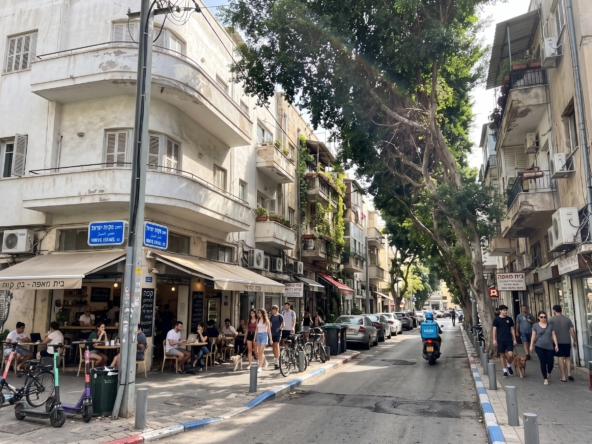
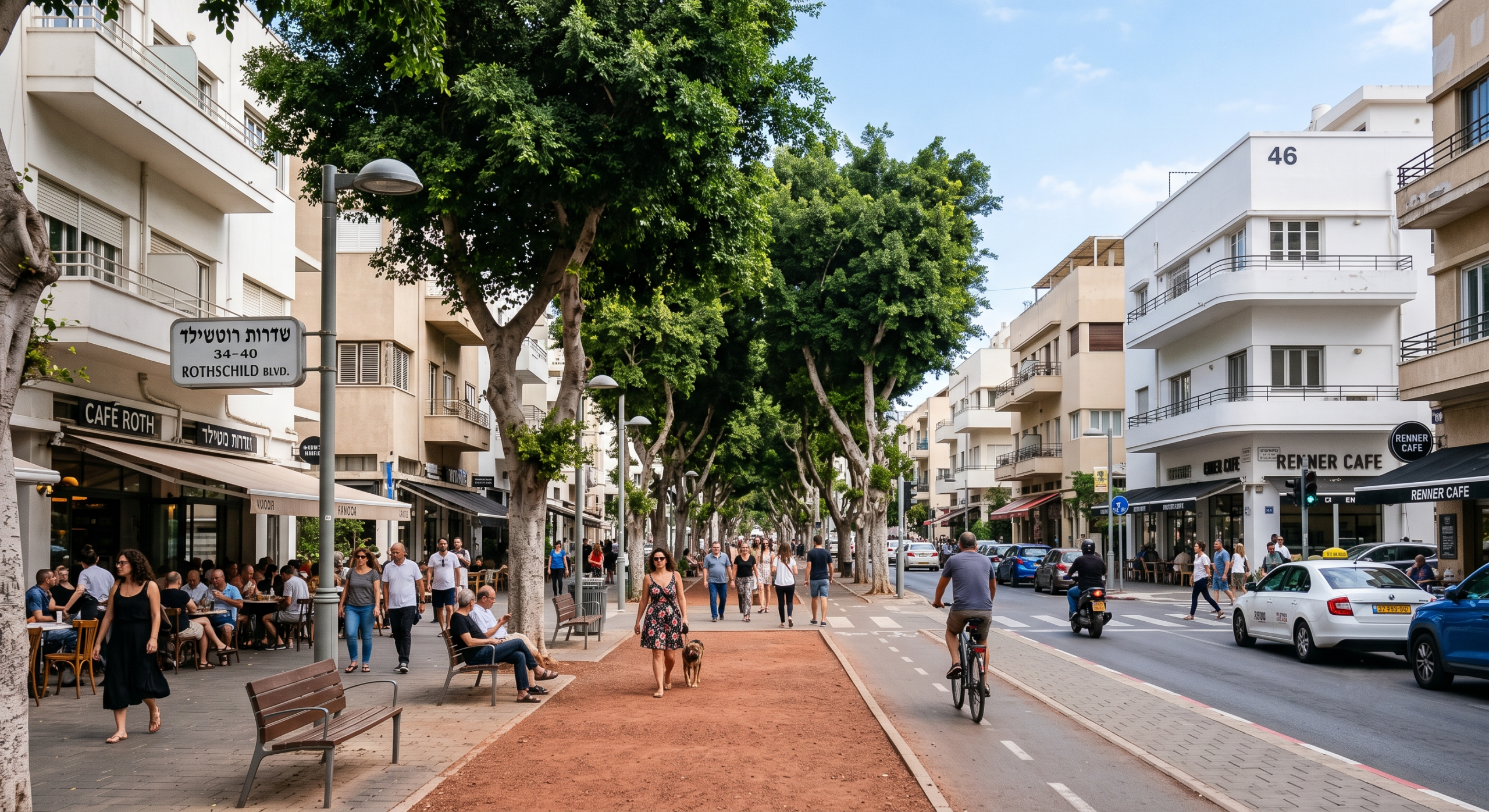
The architectural uniqueness of Rothschild Boulevard is a critical factor in local market stability. The boulevard features a high concentration of buildings designated for strict preservation, primarily built in the Eclectic and International (Bauhaus) styles. This concentration earned the area recognition as a UNESCO World Heritage Site under the umbrella of the “White City.” Tel Aviv’s stringent preservation laws create inherently high barriers to entry for developers, naturally capping the supply of new residential units.
Urban renewal projects in this specific zone require substantial capital investment for the meticulous restoration of historic elements. Consequently, when a renovated property or a historically preserved building enters the market, it is priced as a trophy asset. The housing inventory largely consists of apartments featuring high ceilings, restored wooden shutters, and expansive interior volumes, attracting a very specific demographic willing to pay a premium for historic authenticity paired with meticulous modern design.
Demographic Profile of Buyers and Residents
The population purchasing real estate along Rothschild Boulevard consists of several key segments. First are tech industry executives and young entrepreneurs who value physical proximity to the office buildings along the boulevard and enjoy a lifestyle unreliant on private vehicles. Second is a mature, established demographic, often downsizing from suburban villas to single-level luxury apartments in the city center, right next to primary cultural institutions.
Furthermore, we consistently identify a strong presence of international investors and foreign residents. Working with a dedicated real estate agent in Israel who understands global market dynamics is imperative here. The boulevard’s prestigious status generates a strong sense of investment security for overseas buyers, built on the understanding that this is a hard, tangible asset in an area unlikely to lose its relevance in the coming decades.
The Impact of Future Infrastructure: The Light Rail
The ongoing light rail project, specifically the development of the Purple Line infrastructure crossing nearby Allenby Street, is slated to significantly influence real estate dynamics on Rothschild Boulevard. In the short term, the massive infrastructure works create localized traffic congestion and challenge vehicular accessibility. However, objective real estate analysis indicates that in the medium to long term, the transition to advanced public transportation and the conversion of central streets into pedestrian-prioritized zones will appreciate property values.
The reduction of through-traffic and the expansion of pedestrian areas will amplify the boulevard’s cosmopolitan atmosphere. Properties located on the quiet rear streets branching off Rothschild (such as Shadal, Yavne, or Engel) will particularly benefit from proximity to the new transit options while maintaining optimal privacy.
Investment Analysis: Pros vs. Cons
When evaluating a property acquisition on Rothschild Boulevard, buyers must weigh the following characteristics objectively:
Advantages:
Optimal Value Preservation: Demand for properties on Rothschild remains rigid even during periods of economic volatility, driven by highly restricted supply and a central, unreplicable location.
Complete Urban Lifestyle: Immediate pedestrian access to all daily amenities, high-end dining, cultural institutions, and commercial centers, eliminating the absolute necessity of a private vehicle.
High Rental Potential: Apartments on the boulevard experience constant demand for long-term rentals from embassies, senior executives on relocation, and well-resourced students.
Disadvantages (Points for Consideration):
High Maintenance Costs: Preserved historic buildings require rigorous and ongoing maintenance, and management fees in luxury buildings here are significantly higher than the city average.
Parking Challenges: In historic buildings that have not undergone complete structural renewal or subterranean excavation, the lack of private parking is a significant hurdle.
Acoustic Exposure: Lower-floor, front-facing apartments may experience street noise and commercial activity, necessitating careful evaluation of window insulation or a preference for rear-facing properties for those requiring absolute quiet.
The Strategic Advantage: International Marketing for Value Creation
When managing complex real estate transactions in high-demand areas, it is critical to select a professional who understands the broader, global picture. As a leading realtor in Israel, we know that local reach is sometimes insufficient. At Concord, our operational methodology includes international exposure for foreign residents: active overseas marketing. We advertise our properties on leading international portals to reach investor audiences directly, including diaspora Jews and immigrants from the US, France, and the UK, thereby dramatically increasing competition for the apartment.
This client base is particularly important because these are often affluent individuals who, given the current global situation, are interested in coming to Israel to secure a “safety cushion.” This is a highly quality-driven clientele that the average person in Israel would have some difficulty reaching. This strategy guarantees that properties listed through us receive maximum exposure to the most relevant target audience, unrestricted by geography. Our ability to execute this makes Concord one of the top real estate agencies in Israel, offering precise guidance from the initial search to the final signing. Whether you are buying or selling, partnering with a top real estate agent in Tel Aviv ensures your asset is positioned correctly on the global stage.
Frequently Asked Questions (FAQ)
Is purchasing a preserved heritage property on Rothschild Boulevard considered a secure long-term investment? Yes, preserved properties in central locations benefit from rigid demand and strictly limited supply. Preservation regulations prevent standard high-density construction in the area, securing the uniqueness and inherent value of historic buildings, making them low-risk assets regarding significant long-term depreciation.
What are the day-to-day implications of the Light Rail project on my building’s accessibility? During the immediate construction years, you will experience a redirection of motor traffic and localized challenges accessing specific streets around the Allenby axis. However, upon completion, accessibility to distant locations within and outside Tel Aviv will improve dramatically, and traffic on the boulevard itself is expected to become more pedestrian and light-transit oriented.
Is there a significant difference in appreciation potential between the southern section and the northern section of Rothschild? Both areas are highly sought after but appeal to slightly different demographics. The southern section benefits from proximity to the financial district and Neve Tzedek, attracting more foreign investors and tech executives. The northern section is slightly more residential and appeals to mature buyers looking for proximity to cultural institutions. Appreciation potential is largely identical and is driven by the specific quality of the building rather than its exact coordinate on the boulevard.
To schedule a consultation, property valuation, or a property tour with Concord Real Estate, led by CEO Guy Gidon (Frishman 21, Tel Aviv), contact us at: +972 50-999-0402.